
Best AI Tools for Digital Marketing (2026 Guide)
Discover the Best AI Tools for Digital Marketing in 2026. Compare AI SEO, content creation, automation, analytics, email marketing, and social media tools to boost productivity and ROI.
Artificial intelligence is no longer just a buzzword—it hs become one of the biggest drivers of innovation in digital marketing. Whether you’re a blogger, SEO specialist, agency owner, freelancer, or small business, AI is transforming how campaigns are planned, content is created, and customers are engaged.
From AI content generation and AI copywriting to predictive analytics and marketing workflow automation, modern AI solutions help marketers work faster, make smarter decisions, and achieve better results.
If you’ve searched for the Best AI Tools for Digital Marketing, you’ve probably noticed that there are hundreds of platforms claiming to be the perfect solution.
Some focus on AI-powered SEO, while others specialize in AI social media management, AI-powered email marketing, AI image generation, AI video creation, or marketing analytics.
Choosing the right combination of tools can feel overwhelming, especially when every platform promises to increase productivity and improve return on investment.
The reality is that no single AI tool can solve every marketing challenge. Instead, successful marketers build a connected ecosystem where different tools work together.
For example, you might use an AI platform for keyword research, another for content optimization, and another for marketing campaign automation. When these tools are integrated properly, they streamline repetitive tasks, improve workflow integration, and free up more time for creativity and strategy.
One of the biggest advantages of AI is its ability to improve decision-making through data. Instead of relying on assumptions, marketers can use marketing dashboards, performance tracking, and data-driven marketing insights to understand what works and what needs improvement.
AI also enhances customer segmentation, marketing personalization, and customer journey mapping, allowing businesses to deliver highly relevant experiences at every stage of the buyer’s journey.
This level of hyper-personalization was once available only to large enterprises, but AI has made it accessible to businesses of all sizes.
Search engine optimization has also evolved rapidly with AI. Modern marketers use AI for search intent optimization, semantic SEO, topic clustering, internal linking, and advanced competitor analysis to create content that better matches user expectations.
Rather than focusing only on keywords, AI helps build topical authority by identifying related entities, improving website structure, and supporting better landing page optimization and conversion rate optimization (CRO).
Another area where AI is making a huge impact is automation. With no-code automation, businesses can connect different marketing tools, automate repetitive workflows, and create personalized customer experiences without writing code.
Whether it’s email campaign automation, AI chatbot interactions powered by conversational AI, or lead scoring connected through CRM integration, AI enables marketers to scale their efforts while maintaining consistency and efficiency.
In this comprehensive guide, we’ll explore the Best AI Tools for Digital Marketing in 2026, compare their strengths, discuss real-world use cases, and help you choose the right tools based on your goals.
Whether your focus is SEO, content creation, paid advertising, social media, automation, or analytics, this guide will help you build a smarter and more effective AI-powered marketing stack.
What Are the Best AI Tools for Digital Marketing?
Artificial intelligence has become an essential part of modern marketing, helping businesses streamline workflows, improve customer engagement, and make better decisions through data. The Best AI Tools for Digital Marketing are software platforms that use technologies such as Generative AI, Large Language Models (LLMs), machine learning, and automation to assist marketers with tasks that once required significant manual effort.
These tools are designed to support every stage of the marketing process. For example, AI can help generate blog posts, optimize SEO, create ad copy, schedule social media posts, automate email campaigns, analyze customer behavior, and even predict future trends using predictive analytics. Instead of replacing marketers, AI acts as a powerful assistant that enhances creativity, productivity, and efficiency.
One of the biggest reasons marketers adopt AI is its ability to simplify repetitive work. Tasks like ad copy generation, content repurposing, and social media scheduling can now be completed in minutes. AI also improves brand voice consistency, ensuring that content across blogs, emails, and social platforms maintains the same tone and messaging.
AI marketing tools are commonly used for:
- Creating SEO-optimized blog content through AI content generation.
- Producing persuasive website copy with AI copywriting.
- Automating repetitive tasks using AI marketing automation.
- Improving Google Ads optimization and PPC campaign optimization.
- Enhancing AI-powered email marketing with personalized campaigns.
- Supporting lead generation through AI-driven landing pages and chatbots.
- Monitoring marketing attribution to understand which channels drive conversions.
- Managing multichannel marketing campaigns from a single platform.
- Delivering advanced marketing analytics for smarter business decisions.
As AI technology continues to evolve, marketers who adopt the right tools will be able to create better content, automate routine processes, and deliver more personalized customer experiences than ever before.
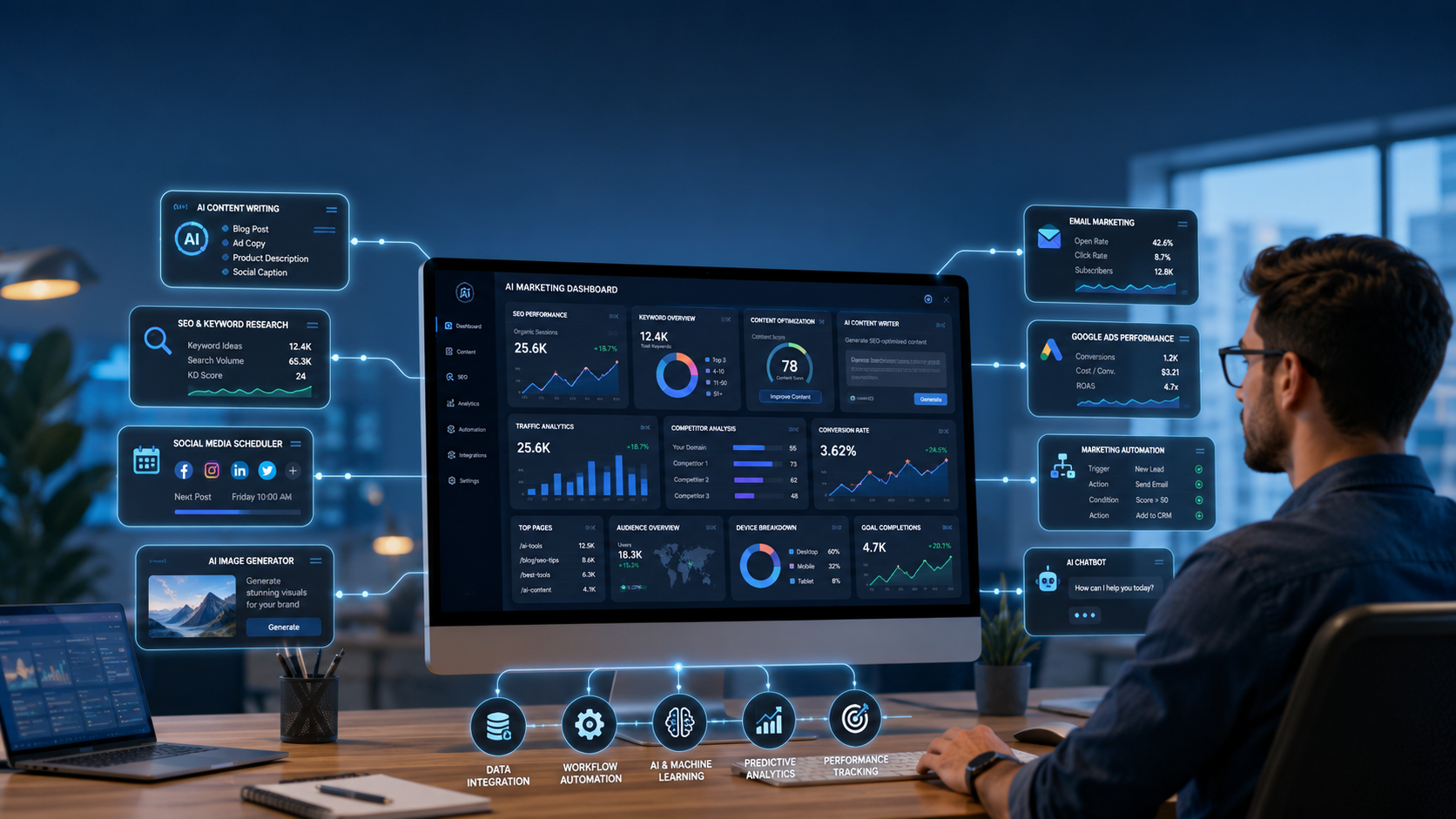
Why Businesses Are Investing in the Best AI Tools for Digital Marketing
The demand for AI marketing tools has grown rapidly because businesses are under constant pressure to produce more content, manage multiple marketing channels, and deliver measurable results—all while controlling costs. AI helps solve these challenges by improving efficiency and enabling marketers to focus on high-value strategic work.
For SEO professionals, AI accelerates keyword research, competitor analysis, and content optimization. It identifies content gaps, recommends related topics, and supports semantic SEO by uncovering entities and search intent that might otherwise be overlooked. When combined with topic clustering and strategic internal linking, AI helps build stronger topical authority, improving visibility in both traditional search results and AI-powered search experiences.
Content marketers also benefit from AI’s ability to generate outlines, draft articles, rewrite existing content, and maintain brand voice consistency. While human editing remains essential, AI significantly reduces the time required to produce high-quality content.
For paid advertising, AI improves Google Ads optimization by analyzing audience behavior, suggesting better targeting, and automating bid strategies. It also supports A/B testing, allowing marketers to compare different headlines, creatives, and landing pages to maximize performance.
Customer engagement has become another major focus. AI enables businesses to create highly personalized experiences through customer segmentation, marketing personalization, and customer journey mapping. By analyzing user behavior, AI can recommend the right message at the right time, increasing conversions and strengthening customer relationships.
Automation is equally important. Modern businesses rely on marketing workflow automation to connect CRM systems, email platforms, advertising tools, and analytics dashboards. Through workflow integration and no-code automation, repetitive tasks can be completed automatically, improving efficiency and reducing the risk of human error.
Ultimately, investing in the Best AI Tools for Digital Marketing is not just about saving time—it’s about making smarter decisions, creating more engaging customer experiences, and building scalable marketing systems that continue to perform as businesses grow.
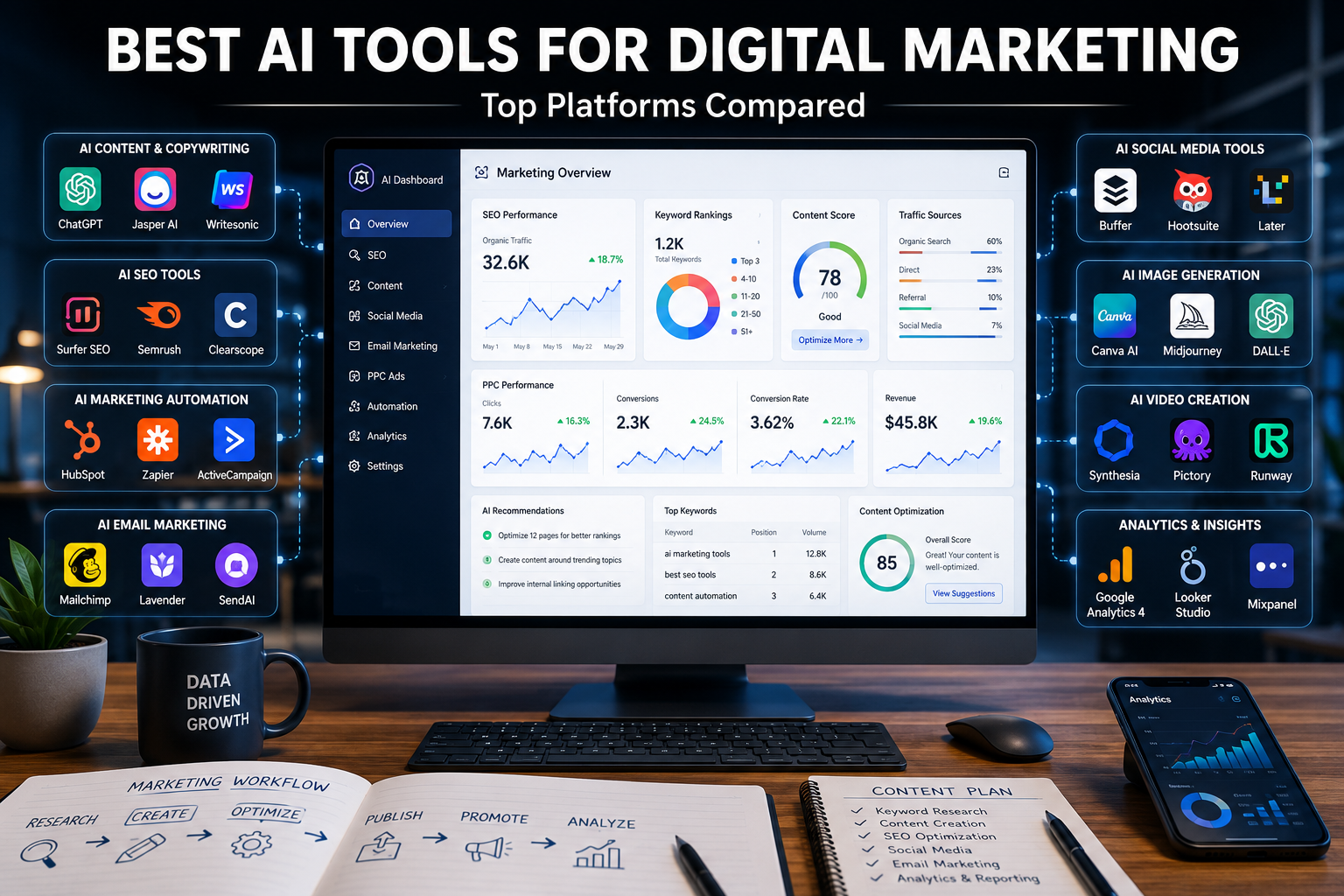
Best AI Tools for Digital Marketing: Top Platforms Compared
Finding the Best AI Tools for Digital Marketing isn’t about choosing the most expensive platform—it’s about selecting tools that match your business goals, budget, and marketing workflow. Some AI tools excel at AI content generation, while others specialize in AI-powered SEO, marketing workflow automation, AI social media management, or marketing analytics.
The best marketers don’t rely on a single platform. Instead, they build an AI-powered toolkit where each solution handles a specific task, from keyword research and content optimization to lead generation, email campaign automation, and performance tracking.
Let’s compare the top AI marketing tools that are helping businesses grow in 2026.
1. ChatGPT – Best AI Tool for Content Marketing & Productivity
ChatGPT has become one of the Best AI Tools for Digital Marketing because of its versatility. Powered by advanced Large Language Models (LLMs) and Generative AI, it helps marketers create high-quality content, brainstorm campaign ideas, and automate repetitive writing tasks.
Best For
- AI content generation
- AI copywriting
- Blog writing
- Ad copy generation
- Prompt engineering
- Content repurposing
Key Features
- Generate long-form blog articles
- Create SEO-friendly outlines
- Write Google Ads and social media copy
- Draft email campaigns
- Rewrite existing content
- Maintain brand voice consistency
Pros
✔ Excellent writing quality
✔ Saves hours of manual work
✔ Supports multiple languages
✔ Great for brainstorming ideas
Cons
✘ Requires human editing
✘ Fact-checking is still necessary
Ideal for: Bloggers, agencies, freelancers, SEO professionals, and content marketers.
2. Surfer SEO – Best AI Tool for SEO Optimization
If your goal is to rank higher on Google, Surfer SEO is one of the Best AI Tools for Digital Marketing focused specifically on SEO.
Rather than guessing what Google wants, it analyzes top-ranking pages and recommends improvements based on semantic SEO, search intent optimization, and content optimization.
Best For
- AI-powered SEO
- Keyword research
- Content optimization
- Topic clustering
- Internal linking
- Competitor analysis
Key Features
- NLP keyword suggestions
- Real-time content scoring
- SERP analysis
- Content editor
- AI article generation
- SEO audits
Why It Matters
Surfer helps writers naturally include related entities, improve topical authority, and optimize content without keyword stuffing.
3. Jasper AI – Best AI Copywriting Tool
Jasper AI is built specifically for marketers who need persuasive marketing copy quickly.
Unlike general AI assistants, Jasper focuses on conversion-oriented writing, making it an excellent option for businesses creating landing pages, sales pages, advertisements, and email campaigns.
Best For
- AI copywriting
- Landing page optimization
- Ad copy generation
- AI-powered email marketing
- Marketing personalization
Features
- Marketing templates
- Landing page copy
- Product descriptions
- Facebook Ads
- Google Ads
- Sales emails
Jasper also helps businesses maintain consistent messaging through customizable brand voice consistency settings.
4. Semrush AI Toolkit – Best AI Tool for Complete Digital Marketing
Semrush has evolved from an SEO platform into a complete digital marketing ecosystem powered by AI.
It combines competitor analysis, marketing analytics, keyword research, and performance tracking in one dashboard.
Best For
- SEO
- PPC
- Marketing analytics
- Google Ads optimization
- Competitor analysis
Key Features
- Keyword Magic Tool
- Site Audit
- Position Tracking
- Backlink Analytics
- AI Writing Assistant
- PPC Research
For agencies managing multiple clients, Semrush simplifies campaign management and provides actionable insights for data-driven marketing.
5. HubSpot AI – Best for Marketing Automation
HubSpot combines CRM with AI to automate nearly every stage of the customer journey.
Instead of using separate tools, businesses can connect sales, marketing, customer service, and analytics within a single platform.
Best For
- CRM integration
- Marketing workflow automation
- Customer journey mapping
- Lead scoring
- Lead generation
- Email campaign automation
Key Features
- AI Email Writer
- AI Blog Generator
- Workflow automation
- Sales automation
- AI chatbot
- Marketing dashboards
HubSpot is particularly effective for businesses focused on scaling operations while delivering hyper-personalization across multiple customer touchpoints.
6. Canva AI – Best AI Image Generation Tool
Visual content is now essential for digital marketing, and Canva AI makes graphic design accessible to everyone.
Best For
- AI image generation
- Social media graphics
- Presentation design
- Marketing creatives
Features
- Magic Design
- AI Image Generator
- Background Remover
- Brand Kit
- Social media templates
Even users with no design experience can create professional visuals for blogs, websites, advertisements, and email campaigns.
7. Synthesia – Best AI Video Creation Platform
Video marketing continues to dominate online engagement, making Synthesia one of the Best AI Tools for Digital Marketing.
Businesses can create professional marketing videos without hiring actors or expensive production teams.
Best For
- AI video creation
- Product demos
- Training videos
- Marketing videos
Features
- AI avatars
- Text-to-video
- Multiple languages
- Screen recording
- Voiceovers
This significantly reduces production costs while speeding up content creation.
8. Buffer – Best AI Social Media Management Tool
Managing multiple social media platforms manually can be time-consuming. Buffer simplifies this process with AI-powered scheduling and content planning.
Best For
- AI social media management
- Social media scheduling
- Content calendars
- Performance tracking
Features
- AI caption generator
- Scheduling automation
- Analytics dashboard
- Engagement reports
- Team collaboration
Buffer allows marketers to maintain a consistent posting schedule while tracking campaign performance from one dashboard.
9. Mailchimp AI – Best for Email Marketing
Email marketing remains one of the highest ROI marketing channels, and Mailchimp uses AI to improve campaign effectiveness.
Best For
- AI-powered email marketing
- Email campaign automation
- Customer segmentation
- Marketing personalization
Features
- AI subject line suggestions
- Audience segmentation
- Predictive analytics
- Customer journeys
- Email automation
AI helps businesses send more relevant emails based on customer behavior, increasing engagement and conversions.
10. Zapier AI – Best No-Code Automation Platform
Automation is one of the biggest advantages of AI, and Zapier connects thousands of applications without requiring coding knowledge.
Best For
- No-code automation
- Workflow integration
- Marketing campaign automation
Features
- Automated workflows
- CRM integrations
- AI actions
- Multi-step automation
- Data synchronization
Marketers can automate repetitive tasks like transferring leads from forms into CRM systems, triggering email sequences, and updating spreadsheets.
Quick Comparison Table
| Tool | Best For | Ideal Users |
|---|---|---|
| ChatGPT | AI content generation & copywriting | Bloggers, Agencies |
| Surfer SEO | AI-powered SEO | SEO Professionals |
| Jasper AI | AI copywriting | Copywriters, Businesses |
| Semrush | SEO & Marketing Analytics | Agencies, Enterprises |
| HubSpot AI | Marketing Automation | Growing Businesses |
| Canva AI | AI Image Generation | Content Creators |
| Synthesia | AI Video Creation | Marketing Teams |
| Buffer | AI Social Media Management | Social Media Managers |
| Mailchimp AI | Email Marketing | Businesses & eCommerce |
| Zapier AI | Workflow Automation | Agencies & Startups |
How These AI Tools Work Better Together
The Best AI Tools for Digital Marketing become even more powerful when used as an integrated system rather than as standalone applications. For example:
- Use ChatGPT for AI content generation and AI copywriting.
- Optimize articles with Surfer SEO using semantic SEO, topic clustering, and internal linking recommendations.
- Design visuals with Canva AI and create engaging videos with Synthesia.
- Schedule posts using Buffer for consistent AI social media management.
- Run AI-powered email marketing campaigns through Mailchimp, using customer segmentation and predictive analytics.
- Connect everything with Zapier using no-code automation and workflow integration.
- Track results in Semrush and HubSpot with detailed marketing dashboards, marketing attribution, and performance tracking to continuously improve your strategy.
How to Choose the Best AI Tools for Digital Marketing
With hundreds of AI-powered platforms available, selecting the Best AI Tools for Digital Marketing can feel overwhelming. Every business has unique goals, budgets, and workflows, so the right choice depends on your specific marketing needs rather than simply choosing the most popular software.
Instead of purchasing multiple expensive subscriptions, start by identifying the biggest challenges in your marketing strategy. Are you struggling to create content consistently? Do you need better SEO rankings? Is your team spending too much time on repetitive tasks? Answering these questions will help you invest in tools that deliver measurable value.
Below are the most important factors to consider before choosing an AI marketing platform.
1. Define Your Marketing Goals First
The most successful businesses don’t buy AI tools because they’re trendy—they invest in them to solve real business problems.
For example:
| Goal | Recommended AI Tool Type |
|---|---|
| Improve SEO | AI-powered SEO tools |
| Write Blog Posts | AI content generation tools |
| Create Ads | AI copywriting tools |
| Manage Social Media | AI social media management platforms |
| Increase Email Sales | AI-powered email marketing |
| Automate Workflows | Marketing workflow automation software |
| Improve Analytics | Marketing analytics platforms |
Having a clear objective ensures that every tool contributes directly to your marketing strategy and return on investment.
2. Consider Ease of Use
Some AI platforms require advanced technical knowledge, while others are designed specifically for beginners.
Look for software that offers:
- Clean dashboard
- Easy navigation
- Templates
- Tutorials
- Customer support
- No-code automation
If your team spends weeks learning the software, productivity may actually decrease before you see results.
User-friendly tools help businesses implement AI much faster while reducing training costs.
3. Check Integration Capabilities
One of the biggest advantages of modern AI marketing software is workflow integration.
Instead of operating independently, your tools should communicate with each other.
For example:
ChatGPT creates content →
Surfer SEO optimizes the article →
Canva AI creates graphics →
Buffer schedules social media posts →
Mailchimp sends newsletters →
HubSpot stores customer information →
Google Analytics measures results
This connected workflow eliminates repetitive tasks while improving overall efficiency.
Businesses using strong marketing workflow automation typically save dozens of hours every month.
4. Look for AI Features That Match Your Needs
Not every AI tool includes the same capabilities.
Before purchasing, compare features such as:
- AI content generation
- AI copywriting
- AI chatbot
- Conversational AI
- Predictive analytics
- Customer segmentation
- Lead scoring
- Marketing personalization
- AI image generation
- AI video creation
- Marketing dashboards
- Performance tracking
Choosing software with features you’ll actually use prevents unnecessary subscription costs.
5. Prioritize SEO Capabilities
If your goal is organic traffic, choose platforms that support AI-powered SEO instead of focusing only on content generation.
The best SEO tools should help with:
- Keyword research
- Competitor analysis
- Search intent optimization
- Semantic SEO
- Topic clustering
- Internal linking
- Content optimization
- Technical SEO recommendations
These features help websites build topical authority while improving search visibility over time.
Best AI Marketing Stack for Different Business Types
Different businesses require different combinations of AI tools.
Bloggers & Affiliate Marketers
Recommended Stack
- ChatGPT
- Surfer SEO
- Canva AI
- Buffer
- Google Analytics
Primary Goals
- Blog writing
- SEO optimization
- Social media promotion
- Traffic growth
Small Businesses
Recommended Stack
- ChatGPT
- HubSpot AI
- Canva AI
- Mailchimp
- Zapier
Primary Goals
- Lead generation
- Customer engagement
- Marketing automation
- Email marketing
Digital Marketing Agencies
Recommended Stack
- Semrush
- ChatGPT
- Jasper AI
- HubSpot
- Zapier
- Buffer
- Canva AI
Primary Goals
- Client management
- SEO
- PPC
- Automation
- Reporting
E-commerce Businesses
Recommended Stack
- ChatGPT
- Mailchimp
- HubSpot
- Canva AI
- Google Analytics
Primary Goals
- Product descriptions
- Email campaigns
- Conversion optimization
- Customer retention
How to Implement AI Marketing Tools Successfully
Purchasing AI software is only the first step. The real value comes from implementing these tools strategically.
Follow this proven implementation process.
Step 1: Audit Your Existing Marketing Process
Before introducing AI, evaluate your current workflow.
Identify:
- Repetitive tasks
- Bottlenecks
- Manual reporting
- Slow content production
- Campaign delays
This helps determine where AI can create the biggest impact.
Step 2: Automate Repetitive Tasks
Start with simple automation.
Examples include:
- Social media scheduling
- Email campaign automation
- Lead notifications
- CRM updates
- Blog publishing workflows
These tasks consume significant time but require minimal creativity.
Step 3: Improve Content Quality
AI should assist writers—not replace them.
A recommended workflow looks like this:
Research →
Keyword research →
Create outline →
Generate draft →
Human editing →
SEO optimization →
Fact-checking →
Publishing
This process combines AI efficiency with human expertise, resulting in higher-quality content that aligns with E-E-A-T principles.
Step 4: Personalize Customer Experiences
One of AI’s biggest strengths is personalization.
Businesses can use AI for:
- Marketing personalization
- Customer segmentation
- Personalized emails
- Product recommendations
- Customer journey mapping
Rather than sending identical messages to everyone, AI delivers content based on user behavior and preferences.
This often leads to higher engagement and improved conversion rates.
Step 5: Monitor Performance
Implementation doesn’t end after launching campaigns.
Continuously monitor:
- Organic traffic
- Keyword rankings
- Conversion rate optimization (CRO)
- Lead generation
- Marketing attribution
- Customer engagement
- ROI
Using marketing analytics and performance tracking helps identify opportunities for improvement while maximizing campaign effectiveness.
Common Mistakes to Avoid When Using AI Marketing Tools
Many businesses expect AI to deliver instant success, but even the Best AI Tools for Digital Marketing require thoughtful implementation.
Avoid these common mistakes:
Using AI Without a Strategy
AI is most effective when aligned with clear business goals and a documented marketing plan.
Publishing AI Content Without Editing
Always review AI-generated content for accuracy, clarity, originality, and brand voice.
Human oversight remains essential.
Ignoring Search Intent
Ranking well requires more than keywords.
Every piece of content should satisfy user intent through valuable, well-structured information.
Over-Automating Customer Communication
Automation improves efficiency, but excessive automation can make customer interactions feel impersonal.
Maintain a balance between automation and genuine human engagement.
Tracking Too Few Metrics
Many marketers focus only on website traffic.
Instead, monitor:
- Leads
- Revenue
- Customer retention
- Engagement
- ROI
- Attribution
- Conversion rates
These metrics provide a more accurate picture of marketing success.
Final Recommendations: Which AI Tool Should You Choose?
If you’re just starting your AI marketing journey, begin with a simple yet powerful stack:
- ChatGPT for AI content generation and brainstorming.
- Surfer SEO for semantic SEO and content optimization.
- Canva AI for creating professional visuals.
- Buffer for AI social media management and scheduling.
- Mailchimp for AI-powered email marketing.
- Zapier for no-code automation and workflow integration.
As your business grows, you can expand your toolkit with advanced platforms like Semrush for competitor analysis and HubSpot AI for CRM integration, lead scoring, customer journey mapping, and enterprise-level marketing automation.
The key isn’t using the most AI tools—it’s choosing the Best AI Tools for Digital Marketing that work together to save time, improve campaign performance, and deliver a better experience for your audience.
Follow me on instagram
For more info contact us