
What Is SEO? A Complete Beginner’s Guide (2026)
Learn what SEO is, how search engines work, and how to improve your website’s Google rankings. This complete beginner’s guide to SEO in 2026 covers on-page, technical, local, and off-page SEO with practical examples.
If you’ve ever wondered “How do websites appear on the first page of Google?”, you’re already asking the question that leads to understanding SEO.
Whether you’re a business owner, blogger, student, freelancer, or digital marketer, learning What Is SEO? A Complete Beginner’s Guide (2026) can completely change how people discover your website online. Every day, billions of searches happen on Google. When someone searches for a product, service, or answer, Google decides which pages deserve to appear on the first page of the Search Engine Results Pages (SERPs).
That decision isn’t random.
It depends on hundreds of ranking signals, including content quality, Search Intent, website performance, relevance, authority, and user experience.
This is where Search Engine Optimization (SEO) comes in.
SEO is the process of improving your website so search engines can understand it better and confidently recommend it to users. Done correctly, SEO helps increase Organic Search Traffic, improves Search Visibility, attracts qualified visitors, and builds long-term trust without paying for every click.
Unlike paid advertising, SEO creates a sustainable source of visitors. A well-optimized article can continue bringing readers for months—or even years—with regular updates.
In 2026, SEO is no longer just about adding keywords to a page. Google’s systems are becoming smarter every year. Technologies like Google AI Overviews, Semantic SEO, Entity SEO, and the Knowledge Graph help search engines understand the meaning behind your content rather than simply matching exact words.
Today’s successful websites focus on solving users’ problems, demonstrating E-E-A-T (Experience, Expertise, Authoritativeness, Trustworthiness), and publishing content that genuinely helps readers.
Whether you’re starting your very first website or trying to grow an existing business, this guide will walk you through everything you need to know—from basic concepts to advanced optimization techniques—in clear, beginner-friendly language.
By the end of this guide, you’ll understand:
- What SEO actually means
- Why SEO matters in 2026
- How Google discovers and ranks web pages
- The three main types of SEO
- How Keyword Research works
- Why Long-Tail Keywords are valuable
- How to improve your content using On-Page SEO
- Why Technical SEO and Off-Page SEO are equally important
- How to measure your SEO performance
- Common SEO mistakes beginners should avoid
- Practical steps you can start using immediately

What Is SEO? Complete Beginner’s Guide (2026) illustration showing Google search results, website optimization, keyword research, and SEO ranking process.
What Is SEO?
If you’re reading What Is SEO? A Complete Beginner’s Guide (2026) for the first time, let’s start with a simple definition.
SEO (Search Engine Optimization) is the practice of improving a website so it appears higher in search engine results when people search for relevant topics.

Imagine you own a bakery.
Someone searches for “best birthday cakes near me.”
Google scans millions of web pages in seconds and decides which businesses should appear first.
If your website is well optimized—with useful content, fast loading pages, relevant keywords, strong reputation, and a good user experience—Google is much more likely to show your website to potential customers.
That’s the power of SEO.
SEO isn’t about tricking search engines.
It’s about making your website the most useful answer to a user’s question.
Google’s mission has always been to organize the world’s information and present the best possible results. Modern SEO aligns with that goal by helping websites provide accurate, relevant, and trustworthy information.
When someone searches online, Google tries to understand:
- What is the user really looking for?
- Which page answers that question best?
- Which website appears trustworthy?
- Which page offers the best experience?
Only after evaluating hundreds of signals does Google determine the order of pages in the Search Engine Results Pages (SERPs).
A successful SEO strategy focuses on creating content that satisfies both search engines and real people.
Instead of writing only for algorithms, you should publish articles that answer questions thoroughly, use logical Header Tags (H1, H2, H3), include descriptive Meta Title Tags and Meta Descriptions, follow clean SEO-Friendly URLs, and organize information in a way that’s easy to read.
At the same time, search engines rely on processes like Website Crawling, Search Engine Indexing, and interpreting NLP Entities to understand your pages. Supporting these processes with a well-structured XML Sitemap, correctly configured Robots.txt, appropriate Canonical Tags, and optimized URL Structure makes it easier for search engines to access and understand your content.
In simple words:
SEO helps search engines understand your website—and helps users find exactly what they’re looking for.
That simple idea forms the foundation of every successful SEO strategy, whether you’re running a personal blog, an e-commerce store, or a digital marketing agency.
Why SEO Is More Important Than Ever in 2026
If you’ve read the first section of What Is SEO? A Complete Beginner’s Guide (2026), you now know that SEO helps websites appear in Google’s search results. But you might still wonder:
“Why should I invest time in SEO when I can simply run ads?”
The answer lies in how people search online today.
Every second, Google processes thousands of searches from users looking for answers, products, services, tutorials, and recommendations. Most users click on one of the top results in the Search Engine Results Pages (SERPs) because they trust Google to show the most relevant and reliable information first.
If your website consistently appears on the first page for topics related to your business, you can attract a steady stream of Organic Search Traffic without paying for every visitor. Unlike paid advertising, where traffic usually stops when your budget runs out, SEO can continue generating visitors long after your content is published.
Think of SEO as building a valuable digital asset. A well-written article can rank for months or even years, bringing qualified visitors who are actively searching for exactly what you offer.
However, SEO in 2026 is no longer about finding a single keyword and repeating it throughout a page. Google’s technology has become much more advanced. It now evaluates whether your content truly satisfies Search Intent, demonstrates E-E-A-T (Experience, Expertise, Authoritativeness, Trustworthiness), and provides a positive Page Experience.
For example, if someone searches “how to improve website SEO,” Google wants to display a page that explains the process clearly, includes practical examples, loads quickly, works well on mobile devices, and answers related questions the user may have. That’s why modern SEO focuses on helping people first and search engines second.
Businesses that understand this shift are more likely to build lasting visibility, earn trust, and grow sustainably.
How Google Search Works
Many beginners imagine that Google stores every website in one giant database and instantly displays results. The reality is far more sophisticated.
Before your website can appear in search results, Google follows three essential steps:
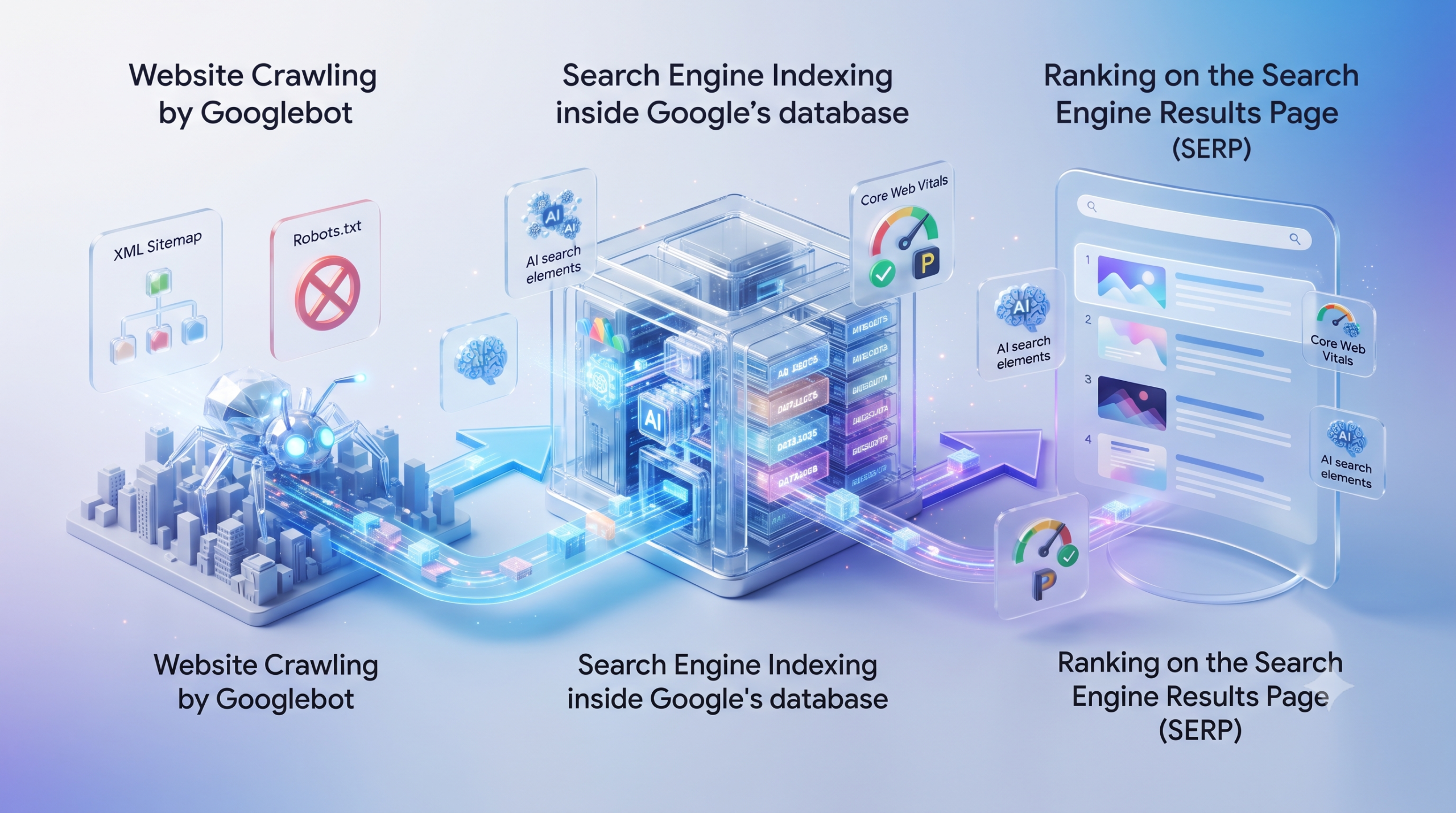
1. Website Crawling
The first step is Website Crawling.
Google uses automated programs called crawlers (often referred to as Googlebot) to discover new and updated pages across the internet. These crawlers follow links from one page to another, collecting information about websites.
You can make crawling easier by maintaining a clear website structure, using logical Internal Linking, and submitting an XML Sitemap. An XML Sitemap acts like a roadmap that tells search engines which pages are important and should be visited.
Your Robots.txt file also plays an important role by telling search engine crawlers which sections of your website they can or cannot access. A properly configured Robots.txt file prevents unnecessary crawling of private or duplicate pages while allowing important content to be discovered efficiently.
For larger websites, managing the Crawl Budget becomes especially important. Crawl budget refers to the number of pages Google is willing to crawl during a certain period. Eliminating unnecessary pages and reducing Duplicate Content helps Google focus on the pages that matter most.
2. Search Engine Indexing
After Google discovers a page, it decides whether that page deserves to be stored in its massive database through a process known as Search Engine Indexing.
Only indexed pages are eligible to appear in Google’s search results.
During indexing, Google analyzes:
- The page’s content
- Headings and structure
- Images
- Links
- Metadata
- Overall quality
This is why creating descriptive Meta Title Tags, informative Meta Descriptions, and well-organized Header Tags (H1, H2, H3) is essential. These elements help both users and search engines understand what your page is about.
Google also looks at your SEO-Friendly URLs, clean URL Structure, properly implemented Canonical Tags, optimized Image SEO, and descriptive Alt Text. Together, these signals help search engines interpret your content more accurately and avoid indexing duplicate versions of the same page.
3. Ranking Pages
Once a page has been crawled and indexed, Google determines where it should appear in the search results.
This decision is made by the Google Search Algorithm, which evaluates hundreds of ranking signals to provide users with the most relevant and trustworthy answer.
Some of the key factors include:
- Relevance to the user’s Search Intent
- Content quality and depth
- Website authority
- High-quality Backlinks
- Effective Link Building
- Strong Anchor Text
- Helpful Content Optimization
- Positive Page Experience
- Fast Page Speed Optimization
- Excellent Core Web Vitals
- Mobile-First Indexing compatibility
- Proper Structured Data (Schema Markup)
Google’s goal isn’t simply to find pages with matching keywords—it wants to understand the meaning behind the content. This is why Semantic SEO, Entity SEO, and recognizing NLP Entities have become increasingly important.
Rather than focusing on exact keyword repetition, Google analyzes how concepts relate to one another. For example, an article about SEO should naturally mention ideas such as keyword research, crawling, indexing, backlinks, search intent, and technical optimization. This contextual understanding helps Google determine whether a page comprehensively answers a user’s query.
Google AI Overviews Are Changing SEO
One of the biggest changes in search is the introduction of Google AI Overviews.
Instead of showing only traditional blue links, Google can now generate AI-powered summaries that combine information from multiple trusted sources. These summaries aim to answer users’ questions directly while still providing links to authoritative websites.
To increase your chances of being referenced in AI-generated results, your content should:
- Demonstrate strong E-E-A-T
- Cover a topic comprehensively rather than superficially
- Use clear, descriptive headings
- Answer common questions directly
- Include related concepts through Semantic SEO
- Organize information logically with topic-focused sections
- Use accurate facts and practical examples
- Build Topical Authority by publishing multiple related articles
Websites that consistently produce high-quality, trustworthy content are more likely to earn visibility in both traditional search results and AI-powered search experiences.
This is one of the main reasons why creating comprehensive guides, maintaining Content Clusters, and connecting them through Pillar Pages has become a successful long-term SEO strategy.
By publishing multiple in-depth articles around the same subject, you help both users and search engines understand that your website is a reliable source of expertise.
As search continues to evolve, the websites that focus on helping users—not manipulating algorithms—will be the ones that earn lasting visibility.
Types of SEO Explained in What Is SEO? A Complete Beginner’s Guide (2026)

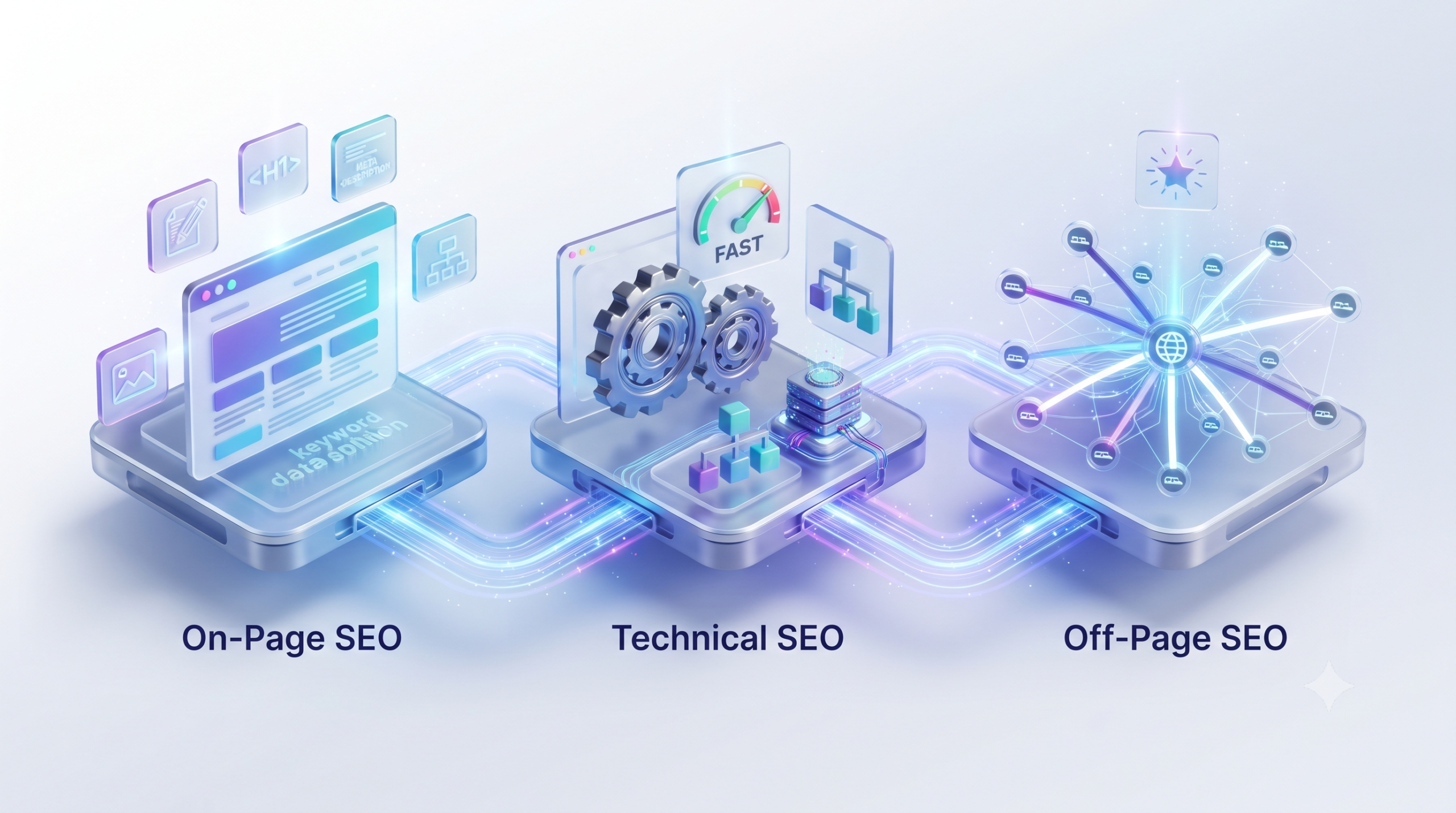
As you continue reading What Is SEO? A Complete Beginner’s Guide (2026), you’ll notice that SEO isn’t just one strategy. Instead, it consists of several interconnected practices that work together to improve your website’s performance in search engines.
To truly understand What Is SEO? A Complete Beginner’s Guide (2026), you must learn the three core pillars of SEO:
- On-Page SEO
- Off-Page SEO
- Technical SEO
Mastering these three areas creates a strong foundation for improving your rankings, increasing Organic Search Traffic, and building long-term Search Visibility.
1. On-Page SEO: Optimizing the Content Users See
A major part of What Is SEO? A Complete Beginner’s Guide (2026) is understanding On-Page SEO. This refers to everything you optimize directly on your website to help both users and search engines understand your content.
Think of On-Page SEO as organizing a library. If every book is clearly labeled, categorized, and easy to find, visitors can quickly locate what they need. The same principle applies to websites.
Important On-Page SEO elements include:
- High-quality content
- Keyword Research
- Using Long-Tail Keywords
- Optimized Meta Title Tags
- Compelling Meta Descriptions
- Proper Header Tags (H1, H2, H3)
- Clean SEO-Friendly URLs
- Logical URL Structure
- Effective Internal Linking
- Relevant External Linking
- Optimized Image SEO
- Descriptive Alt Text
- Helpful Content Optimization
For example, if you’re writing an article on What Is SEO? A Complete Beginner’s Guide (2026), your title should clearly communicate the topic, your headings should follow a logical structure, and your images should include descriptive alt text that helps both accessibility and search engines.
Google rewards content that is easy to read, well-structured, and genuinely useful.
Why Search Intent Matters More Than Keywords
One of the biggest lessons in What Is SEO? A Complete Beginner’s Guide (2026) is that modern SEO revolves around Search Intent.
Search intent answers one simple question:
“What does the user actually want?”
For example:
A user searching for:
“What is SEO?”
expects a beginner-friendly explanation—not an advanced technical document.
Someone searching for:
“Best SEO agency near me”
is looking for a service provider rather than educational content.
Google analyzes search intent before deciding which pages deserve to rank. If your content doesn’t match what users expect, it becomes difficult to appear prominently in the Search Engine Results Pages (SERPs), regardless of how many times you use a keyword.
2. Keyword Research: The Foundation of Every SEO Strategy
No guide titled What Is SEO? A Complete Beginner’s Guide (2026) would be complete without discussing Keyword Research.
Keyword research is the process of discovering the exact words and phrases your audience types into search engines.
Rather than guessing what people want, keyword research helps you create content based on real demand.
For example:
Instead of targeting a broad keyword like:
SEO
you might target more specific Long-Tail Keywords such as:
- What Is SEO? A Complete Beginner’s Guide (2026)
- SEO checklist for beginners
- How to learn SEO step by step
- On-Page SEO guide for WordPress
- Technical SEO basics
- Local SEO for small businesses
Long-tail keywords often have lower competition and attract visitors who know exactly what they’re looking for.
How to Find the Right Keywords
Here are some beginner-friendly methods:
- Google Autocomplete
- People Also Ask
- Related Searches
- Google Search Console
- Google Trends
- Ahrefs
- Semrush
While researching, don’t focus only on search volume.
Also consider:
- Search intent
- Competition
- Relevance
- Business value
- Content quality
The best keyword is one that aligns with your audience’s needs and your website’s expertise.
3. Technical SEO: Helping Search Engines Understand Your Website
Another essential section of What Is SEO? A Complete Beginner’s Guide (2026) is Technical SEO.
Technical SEO ensures that search engines can efficiently crawl, understand, and index your website.
Without a solid technical foundation, even excellent content may struggle to rank.
Important Technical SEO elements include:
- Website Crawling
- Search Engine Indexing
- XML Sitemap
- Robots.txt
- Canonical Tags
- Core Web Vitals
- Page Speed Optimization
- Mobile-First Indexing
- Structured Data (Schema Markup)
Imagine publishing an amazing article but accidentally blocking it in your Robots.txt file. Google may never crawl or index the page, meaning it won’t appear in search results.
Similarly, if multiple URLs display identical content without proper canonical tags, Google may see it as Duplicate Content, reducing your SEO performance.
Technical SEO ensures that your hard work can actually be discovered.
Why Core Web Vitals Matter
Google wants users to have a fast, smooth browsing experience.
That’s why Core Web Vitals are part of Google’s ranking signals.
They measure factors such as:
- Loading speed
- Visual stability
- Responsiveness
Improving your website’s performance through Page Speed Optimization not only benefits rankings but also increases user satisfaction and can improve your Click-Through Rate (CTR) and conversions.
4. Off-Page SEO: Building Trust Beyond Your Website
While On-Page SEO focuses on your own website, Off-Page SEO is about building credibility across the web.
One of the strongest signals is earning high-quality Backlinks from trusted websites.
Think of backlinks as recommendations.
When reputable websites link to your content, Google sees those links as signs that your information is valuable.
However, successful Link Building isn’t about collecting as many links as possible.
Quality matters far more than quantity.
Relevant Anchor Text, links from authoritative websites, and natural mentions contribute to stronger rankings.
Avoid buying spammy backlinks, as they can harm your site’s reputation.
The Role of Topical Authority
Google increasingly rewards websites that cover a subject comprehensively.
Instead of publishing random articles, build Content Clusters around a central topic.
For example:
Pillar Page
What Is SEO? A Complete Beginner’s Guide (2026)
Supporting Articles:
- On-Page SEO Guide
- Technical SEO Guide
- Local SEO Guide
- Keyword Research Guide
- Link Building Guide
- SEO Audit Checklist
- Semantic SEO Explained
Together, these articles form a strong Pillar Page strategy and help establish Topical Authority.
This approach also strengthens Internal Linking, improves navigation, and helps search engines understand the relationships between your content.
By creating comprehensive resources instead of isolated blog posts, you’re far more likely to improve your overall Search Visibility and become a trusted source in your niche.
Semantic SEO: The Future of Search in What Is SEO? A Complete Beginner’s Guide (2026)
If you’ve reached this stage of What Is SEO? A Complete Beginner’s Guide (2026), you’ve already learned about keyword research, technical SEO, and on-page optimization. But in 2026, simply repeating keywords is no longer enough.
Modern search engines are powered by Artificial Intelligence and Natural Language Processing (NLP). Instead of looking for exact keyword matches, Google tries to understand the meaning, context, and relationships between topics.
This is where Semantic SEO becomes essential.
Semantic SEO is the practice of creating content that comprehensively covers a topic by naturally including related concepts, entities, and user questions rather than focusing on a single keyword.
For example, if your article is What Is SEO? A Complete Beginner’s Guide (2026), Google expects your content to naturally discuss concepts such as:
- Search Engine Results Pages (SERPs)
- Keyword Research
- Search Intent
- Technical SEO
- On-Page SEO
- Off-Page SEO
- Core Web Vitals
- Google Search Console
- Google Analytics 4 (GA4)
- Backlinks
- Structured Data
- Page Experience
When all these related topics are covered in a logical way, Google understands that your page provides a complete answer, making it more likely to rank for a wide range of related searches.
What Is Entity SEO?
Another important concept covered in What Is SEO? A Complete Beginner’s Guide (2026) is Entity SEO.
An entity is a clearly identifiable person, place, organization, product, or concept that search engines can recognize independently of keywords.
For example:
- Search Engine Optimization
- WordPress
- Google Analytics
- Google Search Console
- Core Web Vitals
These are all entities.
Instead of relying only on keywords, Google connects these entities to understand the context of your content.
For instance, if your article naturally discusses SEO, Google Search Console, Google Analytics 4 (GA4), Search Intent, Technical SEO, and Backlinks, Google recognizes that these concepts belong to the same topic.
This improves your topical relevance and helps search engines understand that your content is comprehensive rather than shallow.
How the Knowledge Graph Helps Google Understand Your Content
Google organizes information using the Knowledge Graph, a massive database of connected entities and their relationships.
Think of it as a giant digital encyclopedia.
Instead of simply matching words, Google asks questions like:
- What topic is this article about?
- Which entities are being discussed?
- How are these entities related?
- Is this content trustworthy?
- Does it answer the user’s question completely?
When your article naturally includes related entities and provides clear explanations, it becomes easier for Google’s systems to understand your content.
That’s one of the reasons why What Is SEO? A Complete Beginner’s Guide (2026) should explain not only what SEO is but also related concepts like crawling, indexing, rankings, analytics, user experience, and content optimization.
Google AI Overviews: How SEO Is Changing in 2026
One of the biggest developments discussed in What Is SEO? A Complete Beginner’s Guide (2026) is Google AI Overviews.
Instead of only displaying a list of blue links, Google can now generate AI-powered summaries that answer users’ questions directly while citing authoritative sources.
To increase your chances of being included in AI Overviews:
- Write complete and accurate answers.
- Cover topics in depth instead of briefly.
- Use descriptive H2 and H3 headings.
- Answer common questions clearly.
- Demonstrate E-E-A-T (Experience, Expertise, Authoritativeness, and Trustworthiness).
- Support claims with reliable information.
- Keep your content updated regularly.
- Build topical authority through related articles.
Rather than trying to “game” the algorithm, focus on becoming the most helpful resource for your readers.
Measuring SEO Success with Google Search Console
Writing a great article is only half the job. The next step in What Is SEO? A Complete Beginner’s Guide (2026) is measuring your results.
One of the best free tools for this is Google Search Console.
Google Search Console helps you understand how your website performs in Google Search.
It allows you to:
- Monitor keyword rankings.
- Track impressions and clicks.
- Measure Click-Through Rate (CTR).
- Identify indexing issues.
- Submit XML Sitemaps.
- Discover crawl errors.
- Monitor Core Web Vitals.
- Check mobile usability.
- See which pages generate the most organic traffic.
If a page receives many impressions but few clicks, improving your Meta Title Tags and Meta Descriptions may significantly increase your CTR.
Checking Search Console regularly helps you identify opportunities before they become problems.
Understanding Google Analytics 4 (GA4)
While Search Console shows how people find your website, Google Analytics 4 (GA4) explains what they do after they arrive.
GA4 helps answer questions like:
- Which pages are most popular?
- How long do visitors stay?
- Which traffic sources perform best?
- Which devices do users prefer?
- Which pages have the highest engagement?
- Where are users leaving the website?
Combining Google Search Console with Google Analytics 4 (GA4) gives you a complete picture of your SEO performance.
One tool focuses on search visibility, while the other focuses on user behavior.
Together, they help you make smarter content and optimization decisions.
Why Every Website Needs an SEO Audit
Another essential step in What Is SEO? A Complete Beginner’s Guide (2026) is performing an SEO Audit.
An SEO audit is a comprehensive review of your website to identify technical issues, content gaps, and optimization opportunities.
A thorough audit typically includes:
- Checking crawl errors.
- Reviewing Search Engine Indexing.
- Identifying Duplicate Content.
- Improving Internal Linking.
- Fixing broken links.
- Optimizing images and Alt Text.
- Reviewing Core Web Vitals.
- Testing mobile responsiveness.
- Improving Page Speed Optimization.
- Updating outdated content.
- Reviewing structured data implementation.
Think of an SEO audit as a regular health check-up for your website. Small improvements made consistently often produce better long-term results than major changes made once.
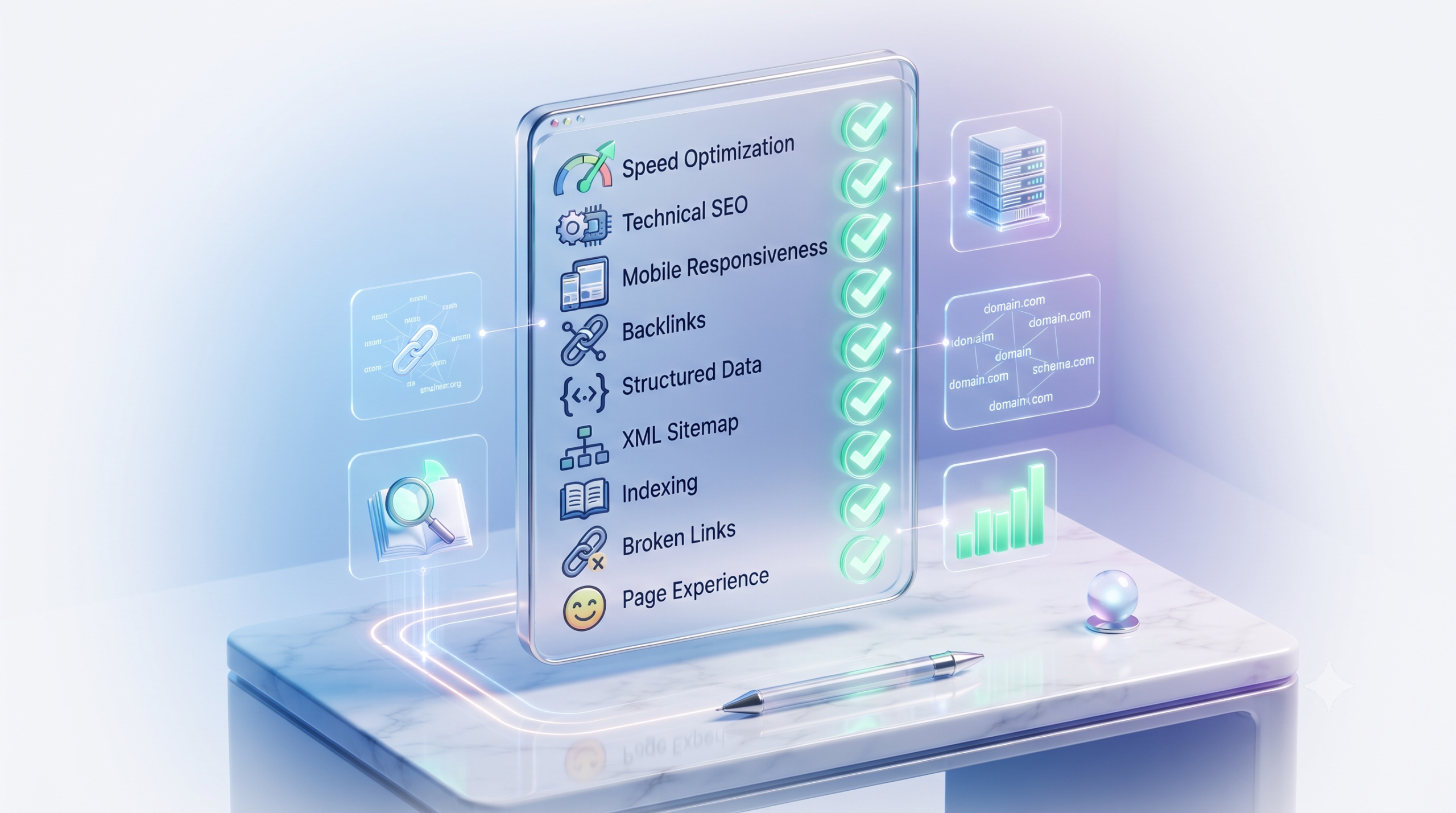
Practical SEO Checklist for Beginners
If you’re implementing the advice from What Is SEO? A Complete Beginner’s Guide (2026), use this checklist before publishing any new blog post:
✅ Identify the primary search intent.
✅ Perform keyword research and choose relevant long-tail keywords.
✅ Write a compelling Meta Title and Meta Description.
✅ Use one H1 and a logical H2/H3 structure.
✅ Add internal links to related articles.
✅ Include a few high-quality external references where appropriate.
✅ Optimize all images with descriptive Alt Text.
✅ Compress images for faster loading.
✅ Ensure your page passes Core Web Vitals.
✅ Use SEO-friendly URLs.
✅ Add structured data (Schema Markup).
✅ Check mobile responsiveness.
✅ Publish genuinely helpful, original content.
Common SEO Mistakes Beginners Should Avoid
Even after reading What Is SEO? A Complete Beginner’s Guide (2026), many beginners make avoidable mistakes that limit their rankings.
Here are some of the most common ones:
- Focusing only on keywords instead of user intent.
- Publishing thin or low-value content.
- Ignoring technical SEO issues.
- Forgetting internal linking.
- Using duplicate titles or meta descriptions.
- Buying low-quality backlinks.
- Ignoring Core Web Vitals.
- Not updating old content.
- Publishing without checking Search Console.
- Expecting SEO results overnight.
Remember, SEO is a long-term strategy. Consistent publishing, regular updates, and continuous optimization are what build lasting organic growth—not shortcuts.
The Future of SEO: What Is SEO? A Complete Beginner’s Guide (2026) and Beyond
If you’ve followed What Is SEO? A Complete Beginner’s Guide (2026) from the beginning, you’ll notice one clear trend—SEO is constantly evolving.
Years ago, websites could rank simply by repeating keywords and building hundreds of backlinks. Today, Google’s AI-powered algorithms are much smarter. They understand context, recognize entities, evaluate user satisfaction, and prioritize content that genuinely helps people.
In 2026 and beyond, successful SEO isn’t about finding loopholes. It’s about creating the best possible experience for your audience while making your content easy for search engines to understand.
Whether you’re running a personal blog, an eCommerce store, a local business website, or a digital marketing agency like Ria Digital, the future belongs to websites that consistently publish helpful, trustworthy, and well-optimized content.
How to Build Long-Term Topical Authority
One of the biggest lessons from What Is SEO? A Complete Beginner’s Guide (2026) is that publishing a single blog post is no longer enough.
Google prefers websites that demonstrate expertise by covering an entire topic rather than just one keyword.
This is known as Topical Authority.
Instead of publishing unrelated articles, create Content Clusters around a central Pillar Page.
For example, your pillar article is:
Pillar Page
What Is SEO? A Complete Beginner’s Guide (2026)
Supporting cluster articles could include:
- Keyword Research for Beginners
- On-Page SEO Checklist
- Technical SEO Explained
- Off-Page SEO & Link Building
- Local SEO Guide
- Semantic SEO Explained
- Google Search Console Tutorial
- Google Analytics 4 for Beginners
- Core Web Vitals Guide
- SEO Audit Checklist
- Best AI SEO Tools
- How Google AI Overviews Work
Each article should link back to your pillar page, and your pillar page should link to every supporting article. This strong Internal Linking structure helps both users and search engines understand your site’s expertise.
For Ria Digital, this strategy can gradually build authority in the SEO niche and improve your overall Search Visibility.
SEO Best Practices You Should Follow in 2026
After reading What Is SEO? A Complete Beginner’s Guide (2026), these are the practices every website owner should follow:
Create Helpful, Original Content
Write for real people first. Every article should answer a specific question or solve a genuine problem.
Match Search Intent
Before writing, ask yourself:
- Is the user looking for information?
- Do they want to compare products?
- Are they ready to buy a service?
When your content matches Search Intent, it has a much better chance of ranking.
Optimize for Mobile Users
Google uses Mobile-First Indexing, so your website should load quickly and work perfectly on smartphones and tablets.
Improve Core Web Vitals
A fast website creates a better Page Experience. Compress images, minimize unnecessary scripts, and use reliable hosting to improve loading speed.
Use Structured Data
Implement Structured Data (Schema Markup) where appropriate. This helps search engines understand your content and may improve your chances of earning Rich Snippets or Featured Snippets in search results.
Earn Quality Backlinks
Focus on building relationships and creating content worth referencing. High-quality Backlinks from relevant websites are much more valuable than a large number of low-quality links.
Update Existing Content
SEO isn’t a one-time task. Refresh your articles regularly with new information, updated examples, and current best practices.
How to Know if Your SEO Strategy Is Working
Without SEO, even an excellent website may struggle to attract visitors. With a well-planned SEO strategy, your content has a much better chance of reaching the right audience and earning sustainable organic traffic.
Many beginners expect results within a few days. However, SEO is a long-term investment.
Instead of checking rankings every hour, monitor these important metrics:
- Organic Search Traffic
- Search Visibility
- Keyword Rankings
- Click-Through Rate (CTR)
- Average Engagement Time
- Bounce Rate
- Indexed Pages
- Core Web Vitals
- Conversion Rate
- Backlink Growth
Using Google Search Console and Google Analytics 4 (GA4) together gives you a complete understanding of how users discover your website and interact with your content.
As your content library grows and your Topical Authority increases, you’ll often see improvements across multiple keywords—not just your primary focus keyword.
Final Thoughts on What Is SEO? A Complete Beginner’s Guide (2026)
 Final Thoughts on What Is SEO? A Complete Beginner’s Guide (2026)
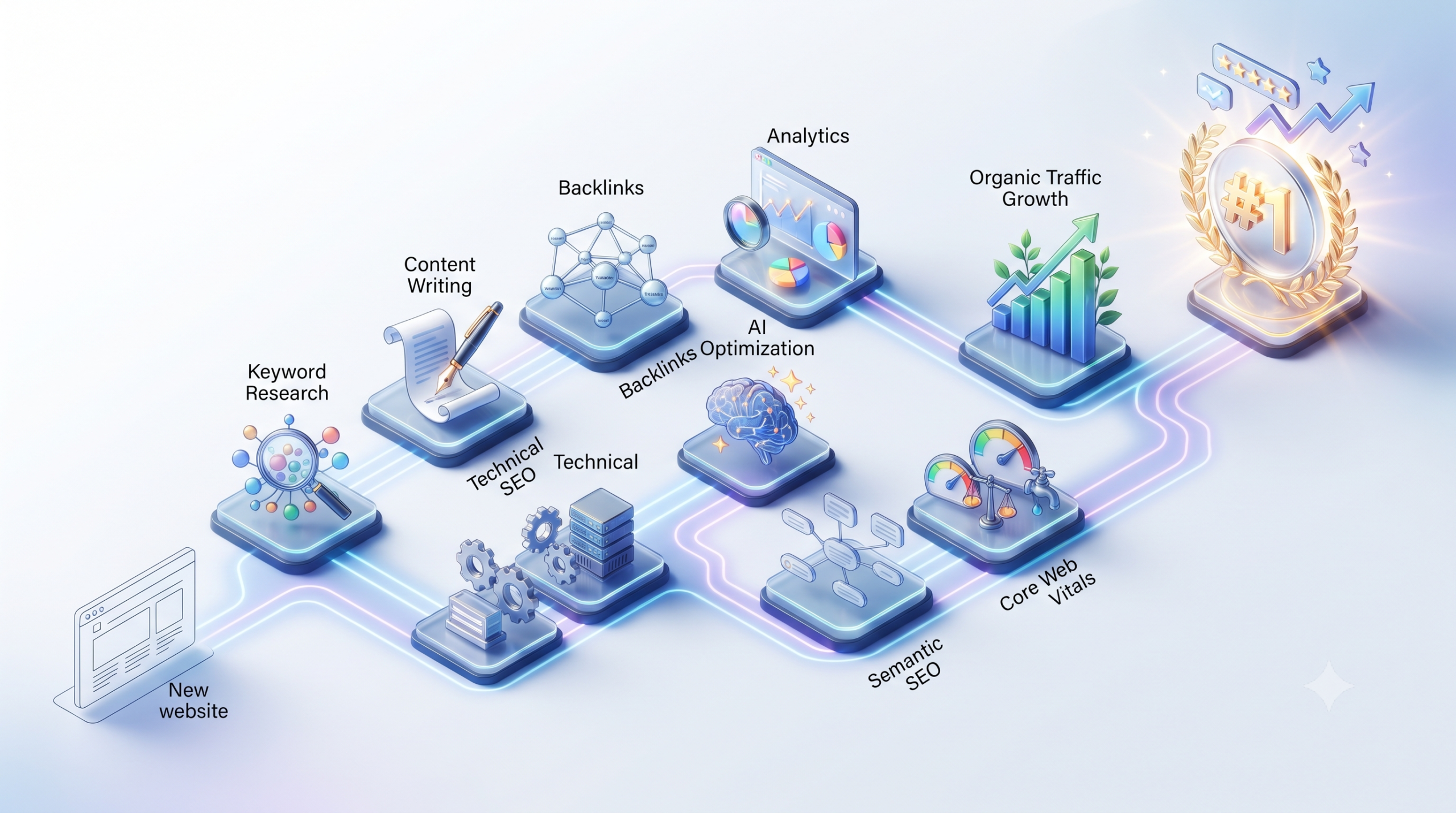
By now, you’ve learned that SEO is much more than simply adding keywords to a webpage.
Throughout What Is SEO? A Complete Beginner’s Guide (2026), we’ve explored how search engines crawl and index websites, how the Google Search Algorithm evaluates content, why Search Intent matters, and how strategies like On-Page SEO, Technical SEO, Off-Page SEO, Semantic SEO, and Entity SEO work together to improve rankings.
You’ve also discovered the importance of Keyword Research, Long-Tail Keywords, Internal Linking, Backlinks, Core Web Vitals, Structured Data, Google AI Overviews, Google Search Console, and Google Analytics 4 (GA4).
The most important takeaway is simple:
SEO is not about manipulating Google—it’s about creating the best possible experience for your audience.
When your website consistently provides valuable, accurate, and well-structured content, search engines are far more likely to reward it with higher rankings and sustainable Organic Search Traffic.
Whether you’re starting your first blog or growing a business website, applying the principles from What Is SEO? A Complete Beginner’s Guide (2026) will help you build a strong foundation for long-term success.
The good news is that SEO is one of the most powerful and cost-effective digital marketing strategies available today. When implemented correctly, it can dramatically increase your website’s visibility, attract qualified visitors, and generate long-term organic growth.
Why Learning SEO Is One of the Best Investments You Can Make
If there’s one digital marketing skill worth learning in 2026, it’s SEO. Unlike paid advertising, where traffic usually stops as soon as your budget runs out, SEO has the potential to deliver consistent, long-term results. A well-optimized article can continue attracting visitors for months or even years.
At the same time, ignoring SEO can make it difficult for your website to compete, no matter how good your products or services are. Many businesses invest heavily in website design but overlook optimization, causing them to miss valuable opportunities for organic growth.
The encouraging news is that SEO isn’t reserved for experts. With patience, continuous learning, and regular content updates, beginners can gradually build authority, improve rankings, and establish a strong online presence. Every small improvement—from writing better content to optimizing page speed—contributes to long-term success.
SEO can completely transform your online presence when implemented correctly. It’s one of the most effective long-term digital marketing strategies for increasing visibility, attracting qualified visitors, and building trust with your audience. The best part is that beginners can start seeing meaningful improvements by consistently applying SEO best practices.
Unfortunately, many websites fail to achieve good rankings because they ignore SEO fundamentals. Poor website structure, slow loading speed, duplicate content, and weak keyword targeting can significantly reduce search visibility and prevent potential customers from finding your business.
Conclusion: What Is SEO? A Complete Beginner’s Guide (2026)
If you’ve made it this far, congratulations! You now have a solid understanding of What Is SEO? A Complete Beginner’s Guide (2026) and the essential strategies that can help your website achieve long-term success in search engines.
Throughout this guide, we’ve explored how Search Engine Optimization (SEO) works, why it matters in today’s digital landscape, and how search engines discover, index, and rank websites. You’ve learned the importance of Keyword Research, understanding Search Intent, improving On-Page SEO, strengthening Technical SEO, building authority through Off-Page SEO, and creating high-quality content that aligns with Semantic SEO principles.
We’ve also covered modern SEO concepts such as Google AI Overviews, Entity SEO, Knowledge Graph, Core Web Vitals, Structured Data (Schema Markup), Google Search Console, and Google Analytics 4 (GA4). Together, these strategies help improve your website’s Search Visibility, attract more Organic Search Traffic, and create a better experience for your visitors.
One of the biggest takeaways from What Is SEO? A Complete Beginner’s Guide (2026) is that SEO is not a shortcut to instant success. It is a long-term investment that rewards consistency, quality, and continuous improvement. Websites that regularly publish valuable content, optimize their technical foundation, earn trustworthy backlinks, and genuinely help users are the ones that build lasting authority and sustainable growth.
If you’re just getting started, don’t try to implement everything at once. Begin with the basics:
- Perform thorough keyword research.
- Create original, helpful content.
- Optimize your titles, headings, and images.
- Improve your website’s speed and mobile experience.
- Build a strong internal linking structure.
- Monitor your performance using Google Search Console and Google Analytics 4.
- Update your content regularly as SEO evolves.
Remember, every successful website started with a single optimized page. By consistently applying the strategies you’ve learned in What Is SEO? A Complete Beginner’s Guide (2026), you’ll be well on your way to building a website that ranks higher, reaches the right audience, and delivers long-term value.
The world of SEO will continue to evolve, but one principle will always remain the same: create content that genuinely helps people. When you focus on solving real problems, answering questions clearly, and delivering a great user experience, you’re building a foundation that both users and search engines appreciate.
🚀 Ready to Improve Your Website’s SEO?
Whether you’re launching your first blog, growing an online business, or looking to generate more organic traffic, the right SEO strategy can make a significant difference.
At Ria Digital, we share practical guides, AI-powered marketing insights, and actionable SEO strategies to help businesses and creators succeed online.
👉 Explore more SEO guides on Ria Digital, learn the latest optimization techniques, and start building a website that ranks, grows, and converts.
Frequently Asked Questions (FAQs) About What Is SEO? A Complete Beginner’s Guide (2026)
1. What Is SEO? A Complete Beginner’s Guide (2026)?
What Is SEO? A Complete Beginner’s Guide (2026) explains the fundamentals of Search Engine Optimization, including how search engines work, keyword research, on-page SEO, technical SEO, off-page SEO, and modern ranking factors like Google AI Overviews and Core Web Vitals. It helps beginners understand how to improve website visibility and attract organic traffic.
2. What is SEO in simple words?
SEO (Search Engine Optimization) is the process of improving your website so it appears higher in search engine results like Google. The better your SEO, the easier it is for people to find your website without paying for ads.
3. Why is SEO important in 2026?
SEO is important because it helps businesses, bloggers, and website owners reach people who are actively searching for their products, services, or information. In 2026, SEO also involves optimizing content for AI-powered search experiences like Google AI Overviews.
4. Is SEO still worth learning in 2026?
Yes. SEO remains one of the most valuable digital marketing skills because it generates long-term organic traffic, builds credibility, and reduces dependence on paid advertising.
5. How do search engines rank websites?
Search engines crawl websites, index their pages, and use algorithms to evaluate hundreds of ranking signals, including content quality, relevance, page experience, backlinks, search intent, and technical performance.
6. How long does SEO take to show results?
SEO usually takes 3–6 months to show meaningful improvements, although highly competitive industries may take longer. Consistency and content quality play a major role.
7. What is the difference between SEO and paid advertising?
SEO focuses on earning free organic traffic through optimization, while paid advertising places your website in sponsored results through advertising platforms like Google Ads.
8. What are the main types of SEO?
The three primary types are:
- On-Page SEO
- Off-Page SEO
- Technical SEO
Many businesses also focus on Local SEO and E-commerce SEO depending on their goals.
9. What is keyword research?
Keyword research is the process of finding the words and phrases people search for online. It helps you create content that matches user demand and search intent.
10. What is search intent?
Search intent is the reason behind a user’s search. Understanding whether someone wants information, comparisons, or a product helps you create content that better satisfies their needs.
11. What are long-tail keywords?
Long-tail keywords are longer, more specific search phrases that usually have lower competition and higher conversion potential than broad keywords.
12. What is technical SEO?
Technical SEO focuses on improving your website’s infrastructure, including crawling, indexing, XML sitemaps, Core Web Vitals, page speed, mobile optimization, and structured data.
13. What is on-page SEO?
On-page SEO includes optimizing content, headings, title tags, meta descriptions, images, internal links, and keyword placement to improve rankings.
14. What is off-page SEO?
Off-page SEO refers to activities outside your website that improve authority, primarily through earning quality backlinks and brand mentions.
15. What are backlinks?
Backlinks are links from other websites pointing to your pages. High-quality backlinks act as trust signals and can improve search rankings.
16. What is Google Search Console?
Google Search Console is a free Google tool that helps website owners monitor search performance, indexing, crawl issues, keyword rankings, and click-through rates.
17. What is Google Analytics 4 (GA4)?
Google Analytics 4 (GA4) helps you understand how visitors interact with your website by tracking traffic, engagement, conversions, and user behavior.
18. What are Core Web Vitals?
Core Web Vitals are performance metrics that measure loading speed, responsiveness, and visual stability to evaluate page experience.
19. What is Semantic SEO?
Semantic SEO focuses on covering a topic comprehensively by including related concepts, entities, and user questions rather than repeating one keyword.
20. What is Entity SEO?
Entity SEO helps search engines understand the people, places, organizations, and concepts discussed in your content, improving topical relevance.
21. Can beginners learn SEO?
Absolutely. Anyone can learn SEO by understanding the fundamentals, practicing consistently, and staying updated with Google’s latest recommendations.
22. Does SEO require coding?
No. Basic SEO doesn’t require coding knowledge. However, understanding HTML, structured data, or technical concepts can be helpful as you advance.
23. Is SEO free?
You can implement many SEO strategies for free using tools like Google Search Console and Google Analytics. Premium SEO tools are optional but can save time and provide deeper insights.
24. How often should I update my SEO content?
Review important articles every 6–12 months, or sooner if there are significant industry changes, new statistics, or Google algorithm updates.
25. What is the biggest SEO mistake beginners make?
A common mistake is focusing only on keywords while ignoring search intent, content quality, user experience, and technical SEO.
26. Can AI help with SEO?
Yes. AI can help with keyword research, content ideas, optimization suggestions, and data analysis. However, human expertise is still essential for creating trustworthy, accurate, and original content.
27. What is local SEO?
Local SEO helps businesses appear in location-based searches, such as “best bakery near me” or “digital marketing agency in Delhi.”
28. How many keywords should I target in one article?
Focus on one primary keyword supported by several relevant secondary and semantic keywords. This creates natural, comprehensive content without keyword stuffing.
29. What is an SEO audit?
An SEO audit evaluates your website’s technical setup, content, backlinks, indexing, speed, and overall optimization to identify areas for improvement.
30. What’s the most important lesson from What Is SEO? A Complete Beginner’s Guide (2026)?
The biggest lesson is that successful SEO is about helping users first. Create valuable content, match search intent, optimize your website technically, and improve it consistently over time. Long-term success comes from quality, relevance, and trust—not shortcuts.
You May Also Like reading this: BEST AI TOOLS FOR DIGITAL MARKETING (2026)
🌐 Explore More at Ria Digital
Follow Ria Digital on Instagram for more valuable content
- 📌 Save SEO tips and digital marketing ideas—join Ria Digital on Pinterest today!
- Recommented article : ChatGPT vs Claude vs Gemini